Bienenstock, Michelson Elected to American Academy of Arts and Sciences
Two SLAC-affiliated professors were recently elected members of the American Academy of Arts and Sciences.
By Glenn Roberts Jr.
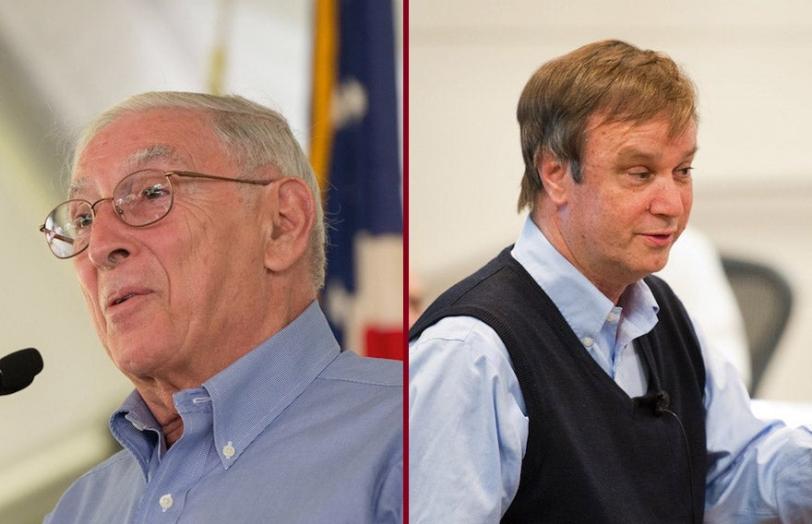
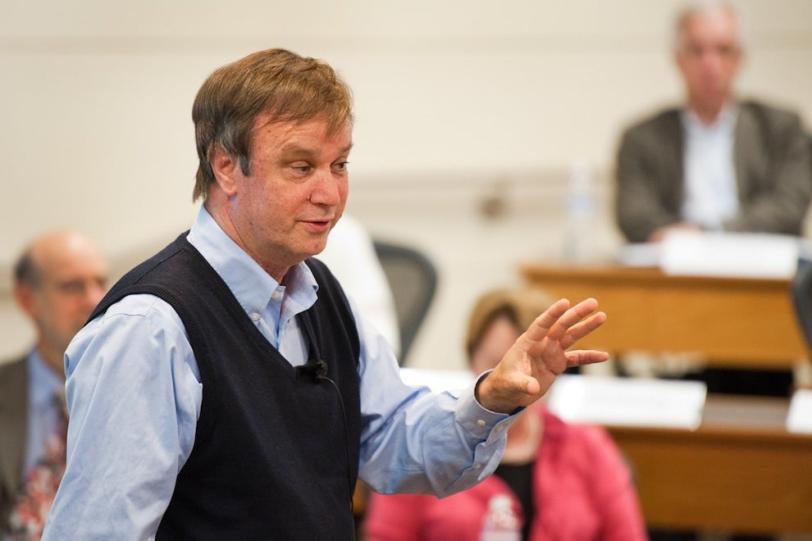
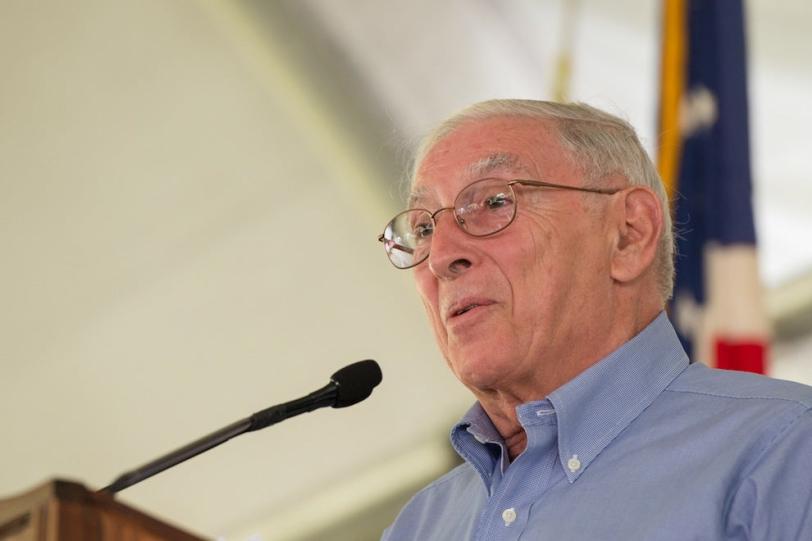
Two SLAC-affiliated professors were recently elected members of the American Academy of Arts and Sciences. Artie Bienenstock, professor emeritus of photon science at SLAC and member of the National Science Board, and Peter Michelson, a SLAC and Stanford astrophysicist and Stanford professor, will be inducted at a ceremony Oct. 12 at the academy's headquarters in Cambridge, Mass.
They join a group of about 4,000 U.S. fellows and 600 foreign honorary members of the prestigious policy research center, which conducts studies and provides possible policy choices for a variety of social and intellectual issues. The group's membership has expertise in fields ranging from mathematics to social sciences and humanities, and from physical and biological sciences to the arts and public affairs.
Michelson helped to develop the Large Area Telescope (LAT), has served as its principal investigator and is now a spokesman for the LAT collaboration. The LAT is the main instrument aboard the Fermi Gamma-ray Space Telescope, which has amassed a large and growing list of important discoveries since its launch in June 2008. The LAT team shared the 2011 Bruno Rossi Prize.
"I was surprised to learn of my election to the academy and feel honored to be elected a member," he said. He was one of eight new members elected in the academy's Astronomy and Earth Sciences section, which includes astrophysics. In total, the academy elected 198 new members this year, among them seven Stanford professors.
"What I find most interesting about the American Academy of Arts and Sciences is that it represents both the arts and the sciences," Michelson said. "I truly believe that the arts and humanities and the sciences all make important contributions to society. I feel very privileged to be a member of the academy." In addition to his LAT role, Michelson is director of the W.W. Hansen Experimental Physics Laboratory at Stanford.
Bienenstock serves as special assistant to Stanford President John Hennessy for federal research policy and is a former director of the Stanford Synchrotron Radiation Lightsource.
"It's a delight to join Peter Michelson in election to the academy," he said. "Each of us played a significant role in SLAC's evolution towards synchrotron radiation and particle astrophysics. It was SLAC and SSRL that led me toward the science policy contributions that the Academy notes.
"I am grateful to former SLAC directors Pief Panofsky and Burt Richter, whose tutelage helped me to be successful in the policy arena, as well as to the SSRL staff, faculty and users, whose contributions to the facility's development made synchrotron radiation of both scientific and policy importance nationally and internationally," Bienenstock added. "Of course, none of this would have happened without SLAC's great high-energy physics contributions."
He also acknowledged support for scientific research and policy development by colleagues at federal agencies including the Department of Energy, Office of Management and Budget and Office of Science and Technology Policy. Bienenstock is one of seven new members elected to the academy's Engineering Sciences and Technologies section.
Among the academy's other new members this year:
- Ernest Moniz, nominee for secretary of the U.S. Department of Energy.
- Former pilot, astronaut and Senator John Glenn.
- Actors Robert DeNiro and Sally Field.
- Musicians Herbie Hancock, Pete Seeger and Bruce Springsteen.
The academy was founded in 1780 and its membership includes about 250 Nobel Prize and 60 Pulitzer Prize recipients.
Contact
For questions or comments, contact the SLAC Office of Communications at communications@slac.stanford.edu.
(Credit: Linda A. Cicero/Stanford News Service)
Related stories
Seagull Nebula through the eyes of NSF–DOE Vera C. Rubin Observatory Commissioning Camera